


On September 14-15, 2026, Ukrenergo held the inaugural session of its renewed Integrity Ambassadors 2.0 programme in Kyiv - a two-day programme bringing together employees from different professional areas and from various parts of Ukraine to strengthen integrity, compliance awareness, and responsible decision-making across the company.
On the second day of the programme, Oleg Lagodiienko, founder of Ethicontrol, delivered the final lecture of the programme, Speak Up: How to Talk About Risks and Violations.
The programme was designed not simply as another compliance training, but as the beginning of a community that can help make integrity part of everyday work.
From a formal programme to a community of integrity
According to Ukrenergo, Integrity Ambassadors 2.0 is a renewed initiative designed to bring together employees who are ready to support a culture of integrity within their teams and daily work.
An Ambassador is not a formal position or another layer of control. The programme describes an Ambassador as someone trusted by colleagues, who understands the value of personal responsibility and is prepared to discuss difficult issues openly, help find solutions, and act as a driver of positive change in their working environment.
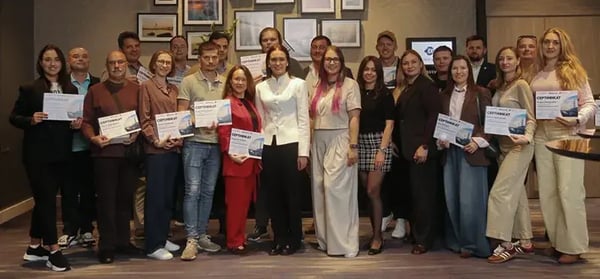
This approach was reflected in the composition of the community itself. Participants came from very different professional backgrounds, including engineers, design engineers, dispatchers, analysts, technical specialists, and employees working across operational and corporate functions.
That diversity matters. Integrity-related questions do not belong exclusively to compliance departments. They emerge in procurement, operations, finance, HR, technical processes, communications, and everyday interactions between colleagues.
The aim of the programme is therefore practical: to help employees understand how the company's integrity system works, recognize risks, use available mechanisms, communicate about difficult situations, and apply their knowledge to real workplace decisions.
Two days of practical learning
The two-day programme brought together experts in business, government, anti-corruption, compliance, OSINT, journalism and civil society, including representatives of Ukrenergo, NACP, NABU, UNIC, Molfar Intelligence, the Basel Institute on Governance and Ethicontrol.
The broader perspective was provided by investigative journalist Yurii Nikolov, co-founder of Nashi Groshi; Serhii Rokun from ID Ukraine; Oleksii Podoliev from OКR; Liliia Chorna, business trainer at Ukrenergo; and Father Georgiy Kovalenko, Rector of the Open Orthodox University. Ethicontrol delivered the lecture on Speak Up culture.
Integrity risks in procurement
One of the practical sessions was dedicated to integrity risks in procurement, delivered by Oleg Mykhaliuk from the Basel Institute on Governance. The discussion focused on conflicts of interest, corruption and fraud, as well as the key risks that can emerge at different stages of the procurement cycle.
Rather than looking at procurement risks only as major or obvious violations, the session focused on the smaller warning signs - red flags - that can help identify potential problems at an earlier stage.
Among the examples discussed were a large number of fragmented invoices, repeated invoices containing unusually many round figures, and situations where all bidders in a tender appear significantly weaker than the alternative or expected market level.
Such patterns do not automatically prove wrongdoing, but they can indicate that additional attention or verification is needed.
During the interactive compliance game “Find the Risk,” participants worked through a simulated business scenario and identified potential risks of corruption, fraud, conflicts of interest, and collusion.
Fact-checking in an age of information overload

Another particularly relevant session focused on fact-checking, manipulation and disinformation. The lecture was delivered by Yuliia Dukach from the Molfar Intelligence Institute and covered the basic principles of verifying facts, identifying manipulation and disinformation, as well as a practical exercise on checking information and its sources.
For Integrity Ambassadors, this topic is increasingly relevant. Integrity is not limited to financial or compliance risks; it also depends on the quality of information on which people base their decisions.
In an environment where manipulated content, misleading headlines and AI-generated or selectively edited materials can spread quickly, the ability to pause, question a source and verify information becomes an important professional skill.
Participants were also introduced to a media whitelist, a practical reference list of media sources considered suitable for reliable information checking. The list included Suspilne Media, which is also an Ethicontrol client.
The session reinforced an important principle: fact-checking is not only about determining whether a particular statement is true or false. It is also about understanding where information comes from, what context may be missing, how it may have been manipulated, and whether the source itself can be trusted.
Speak Up: How to talk about risks and violations
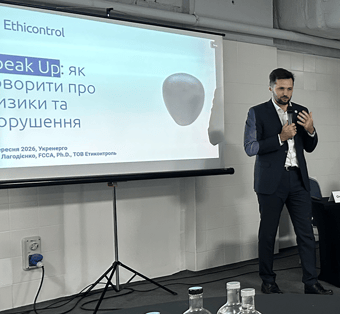
Oleg Lagodiienko’s speech brought the discussion back to one of the most practical aspects of integrity systems: a reporting system can exist as a policy or procedure, but an integrity culture depends on whether people are actually willing to use it.
The software Ethicontrol helps organizations create secure reporting channels, protect reporters’ confidentiality and anonymity where appropriate, manage cases and investigations, and turn compliance procedures into practical workflows. However, technology is only one part of the system - a reporting channel alone cannot create a culture of integrity.
This is why initiatives such as “Integrity Ambassadors 2.0” are important: they connect systems and procedures with the people who use them every day.
One of the most active discussions focused on whistleblower rewards in Ukraine, where they are provided by law, and on the distinction between financial compensation and actually “profiting” from reporting. Given the potential professional and personal consequences for whistleblowers, financial rewards can be viewed as compensation for future losses and risks rather than simply a way to earn money from a report.
The discussion also raised a broader question: if people report misconduct only because they expect a reward, can this create a sustainable Speak Up culture? An example was given that paying people for every book they read could gradually turn reading into a transaction. Similarly, integrity may require something deeper than external incentives - an understanding that certain actions have value even when they do not provide immediate personal benefit.
Conclusion
One of the program participants referred to himself not as a compliance officer, but as a “сompliance private.” The phrase was informal, but it very accurately conveyed an important principle: integrity does not belong to a single department nor exclusively to compliance officers.
Every employee may face a conflict of interest, spot a red flag, receive sensitive information, find themselves in an ethical dilemma, or be the person a colleague turns to with a difficult question. Integrity is often discussed in terms of policies, procedures, controls, and mechanisms. All of this is important. But these elements only make sense when they influence day-to-day behavior. Father Georgiy Kovalenko summed up this idea as follows: “We declare our values; we practice our virtues.”
The next step: from knowledge to action, and from action to culture.