


On September 26, 2025, COMPLIANCE & INTEGRITY FORUM. ESG FORCE – 2025, organized by Business-Format Group, took place in Kyiv at the Ramada Encore Kyiv Hotel. The event brought together compliance officers, risk managers, business representatives, and experts to discuss key challenges related to ESG implementation, compliance digitalization, and the role of integrity in corporate governance.
The Ethicontrol team joined the forum as an expo partner to engage with the professional community and share practical solutions for automating compliance processes, incident management, and whistleblowing channels.
The forum’s core focus was ESG as a strategic challenge for business — from regulatory requirements and governance dilemmas to practical tools for integrating ESG into compliance, risk management, and daily operational processes.
Forum Agenda
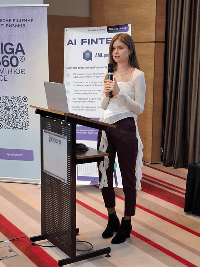 Yana Konok (Executive Director of ASDE, Head of ISA)
How to Deliver a Successful ESG Transformation: Mechanisms for Implementing an Effective ESG Strategy
The presentation clearly emphasized that ESG is no longer a voluntary initiative or a reputational add-on for Ukrainian businesses. EU regulations (CSRD, ESRS, EU Taxonomy) are effectively extending to Ukrainian companies through banks, investors, and international supply chains. The key issue highlighted by the speaker was “ESG on paper,” where companies formally report but fail to implement real process changes.
The practical part of the presentation focused on a step-by-step ESG transformation model: double materiality assessment, defining 3–5 priority ESG goals linked to financial KPIs, and building ESG governance and data systems. Particular attention was given to emissions inventory, supplier engagement through ESG due diligence, and the financial logic of ESG — specifically how alignment with the EU Taxonomy directly affects access to capital, credit terms, and competitiveness in tenders.
Mykhailo Shomin (Independent Member of the Supervisory Board of “Ukrainian Capital” Bank)
COMPLIANCE & INTEGRITY: ESG as a Strategic Challenge — Development or Loss of Focus
The speaker examined ESG through the lens of corporate governance and integrity, emphasizing the risks of superficial implementation. Key challenges include fragmented regulation, differing approaches between the EU and the US, and growing legal liability for inaccurate ESG statements. According to the speaker, ESG is increasingly becoming a source of strategic and reputational risk when it is not fully integrated into governance systems.
From a practical perspective, Mykhailo stressed the role of supervisory boards and top management in setting ESG priorities, as well as the need for clear accountability for ESG decisions. ESG should be embedded within compliance, risk management, and internal control systems, rather than treated as a standalone function detached from business objectives.
Mykhailo Koltsov (Head of Learning and Development at YouControl; External Consultant to the World Bank on Data Analysis and Cybersecurity)
ESG: Strategic Development or Imitation of Compliance
The presentation focused on the risks of a formalistic ESG approach and the dangers of greenwashing. The speaker demonstrated that companies often concentrate on reporting without having effective tools to verify data, counterparties, and supply chains, which creates both regulatory and reputational risks.
The practical focus was on the use of analytical and digital tools to assess ESG risks, counterparties’ financial sustainability, and compliance with declared standards. Ultimately, ESG must be based on verified data and transparent sources rather than declarations in non-financial reporting alone.
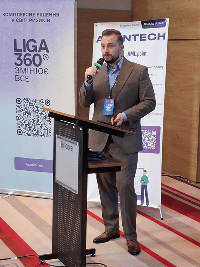 Yevhen Myasushkin (Founder of the AI platform for business process and banking automation, Tur.ai)
Digital Tools to Improve Compliance and ESG Effectiveness
The speaker focused on the practical application of AI solutions in compliance and ESG processes. Automation was shown to reduce the workload of compliance officers, accelerate KYC/AML procedures, sanctions screening, and risk monitoring, while maintaining quality control.
Special attention was given to the Human-in-the-Loop approach, where key decisions remain with people while technology enhances analytics and scalability. The key takeaway was that effective ESG and compliance implementation is impossible without digital support, especially amid increasing regulatory demands and data volumes.
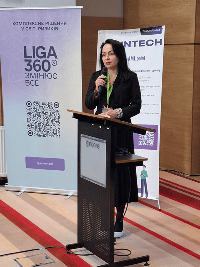 Hanna Horbenko (Director of the Compliance and Financial Monitoring Department at OTP Bank; Head of the Ukrainian Compliance Association)
Automation of the Compliance Function in a Regulated Environment
The presentation illustrated how automation transforms the compliance function from reactive control to proactive risk management. The speaker emphasized that without digital solutions, compliance functions struggle to keep pace with regulatory requirements and internal processes.
The practical part covered the development of compliance monitoring systems, data integration, case management, and management reporting. The importance of balancing automation with expert judgment, particularly in the financial sector, was highlighted.
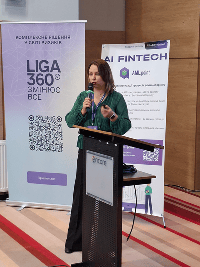 Oksana Hubina (Head of RegTech Projects, AI Fintech)
Customer Experience in AML Processes
The speaker addressed the conflict between AML requirements and customer experience, demonstrating that overly complex or non-transparent AML procedures lead to business losses and reduced customer loyalty.
The practical focus was on using RegTech and AI solutions to optimize AML processes, shorten verification timelines, and improve communication with customers. The conclusion was that AML can remain effective without harming customer experience when processes are properly designed.
Anastasiia Afanasieva (Regional Head of Integrity and Compliance – UBA, ACINO UKRAINE LLC, a company of Acino, part of Arcera)
The Evolution of Due Diligence: From Formality to ESG Risk Management
The presentation demonstrated how due diligence is transforming under ESG requirements. Traditional checks no longer adequately cover key risks related to human rights, environmental impact, and supply chains.
The practical section focused on implementing risk-based due diligence models, applying ESG criteria, and integrating assessment results into management decisions and contractual relationships with partners.
Iryna Oliinyk (Head of ESG and Sustainability Coordination within the Compliance Function at TASCOMBANK)
Compliance in Financial Groups: Practical Challenges and Solutions
The speaker shared experience in building a compliance system within a large financial group, highlighting typical challenges such as coordination between business lines, regulatory compliance, and group-level risk management.
The practical emphasis was placed on clear role allocation, standardized procedures, and transparent communication between compliance and business units as key drivers of effectiveness.
Olena Chekushyna (Risk Management Expert, Business Development Manager at MIDOT (Israel) in Ukraine)
Compliance as the Foundation of ESG Trust
The presentation emphasized that ESG without a mature compliance system creates significant legal and reputational risks. The speaker focused on the role of compliance in validating ESG data, policies, and disclosures.
The practical focus was on integrating ESG risks into compliance controls, internal investigations, and accountability frameworks to ensure trust from investors and regulators.
Tetiana Hromova (Director of the Compliance Department at Ukrzaliznytsia)
Integrating ESG Risks into Enterprise Risk Management
The speaker presented ESG as an integral part of overall risk management rather than a separate discipline. The presentation showed how ESG risks should be identified, assessed, and monitored alongside financial and operational risks.
The key takeaway was that ESG risks must be embedded in risk maps, management KPIs, and regular reporting to governing bodies.
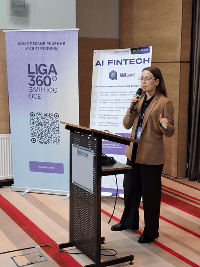 Mariana Tekliuk (Business Integrity Academy Lead, UNIC)
Integrity as the Foundation of ESG and Compliance Systems
The presentation focused on the link between integrity culture, anti-corruption practices, and ESG. The speaker emphasized that without a strong internal ethics culture, ESG initiatives remain largely formal.
The practical emphasis was on the role of education, professional communities, and behavioral standards in building a sustainable ESG ecosystem.
Valerii Mykhailovskyi (Senior Manager, Sustainability Services (ESG), PwC Ukraine)
ESG in the Financial Sector: From Requirements to Implementation
The speaker examined ESG challenges facing financial institutions, particularly the assessment of climate and social risks in loan portfolios. The importance of ESG data in financial decision-making was emphasized.
The practical conclusion was that ESG is gradually becoming part of financial logic rather than remaining solely within non-financial reporting.
Denys Shchur (Business Development Manager for Ukraine, Baltics, and Northern Europe at ACCA)
The Role of Professional Standards in ESG and Compliance Development
The presentation demonstrated how international professional standards support the development of ESG and compliance functions. The speaker highlighted the importance of professional training and continuous learning.
The practical focus was on building competencies required for ESG reporting, risk management, and ethics in modern organizations.
Overall Impressions
COMPLIANCE & INTEGRITY FORUM. ESG FORCE – 2025 clearly demonstrated that ESG and compliance are moving from formal requirements to the realm of strategic management. Businesses are increasingly seeking practical tools — digital solutions, automation, clear KPIs, and effective communication channels.
We thank Business-Format Group for a substantive and relevant forum and for creating a professional environment for experience sharing. Ethicontrol will continue to support similar initiatives and actively participate in events that foster the development of compliance, integrity, and ESG culture in Ukraine.
Share the article


