


Compliance teams are increasingly expected to prove that their programs do more than meet regulatory requirements. Boards and executives want to understand whether compliance actually reduces risk, helps detect problems earlier, improves decision-making, and protects the business from financial, legal, and reputational damage.
But compliance effectiveness cannot be proven only by counting completed trainings, signed policies, hotline reports, or closed cases. These numbers show that certain activities happened, but they do not always show whether the program works in practice. A company can pass an audit and still miss emerging risks. It can have a reporting channel and still lack employee trust.
That is why compliance measurement should focus on outcomes, not just activity. In this article, we explain how to measure compliance effectiveness, which metrics matter most, how to connect compliance data to business value, and how to turn reporting into a stronger case for investment, accountability, and continuous improvement.
Table of contents:
- Why compliance effectiveness is hard to measure
- What compliance effectiveness really means
- Start with business objectives and risk priorities
- KPIs, KRIs, leading and lagging indicators: what to track
- Core compliance metrics every program should consider
- How to calculate compliance ROI and business value
- Turning compliance data into board-ready reporting
- Compliance maturity: from manual reporting to strategic value
- How technology helps measure compliance effectiveness
- Common mistakes in measuring compliance effectiveness
- How to build your compliance measurement framework step by step
- Conclusion: compliance value must be measured, not assumed
- FAQ
Why compliance effectiveness is hard to measure
.webp?width=126&height=400&name=Why%20Compliance%20Effectiveness%20Is%20Hard%20to%20Measure%20(1).webp) Measuring compliance effectiveness is difficult because compliance does not always produce visible results. When a program works well, many problems are prevented before they become investigations, fines, lawsuits, or public scandals. This makes the value of compliance harder to prove than sales, marketing, or operational performance, where outcomes are often easier to connect to revenue or cost savings.
Measuring compliance effectiveness is difficult because compliance does not always produce visible results. When a program works well, many problems are prevented before they become investigations, fines, lawsuits, or public scandals. This makes the value of compliance harder to prove than sales, marketing, or operational performance, where outcomes are often easier to connect to revenue or cost savings.
Many organizations also rely too heavily on activity-based indicators, such as completed training, signed policies, hotline reports, or closed cases. These metrics are useful, but they do not prove that risks are being reduced or behavior is changing. To measure effectiveness properly, organizations need to ask deeper questions: Are issues detected early? Are reports handled consistently? Are root causes addressed? Are corrective actions completed? Are employees willing to speak up?
Compliance is often measured by activity, not impact
Many compliance reports focus on what was done rather than what changed. For example, a company may report that 98% of employees completed annual compliance training. That sounds positive, but it does not answer whether employees understood the content, applied it in real situations, or felt more confident reporting misconduct.
The same problem appears in other areas. Counting hotline reports does not automatically show whether the speak-up culture is healthy. Counting closed investigations does not show whether cases were handled fairly or whether similar issues will happen again. Counting policy attestations does not prove that employees follow the policy in practice.
Activity metrics are still important, but they should be treated as the starting point. To prove effectiveness, compliance teams need to connect those activities to outcomes such as earlier detection, faster remediation, fewer repeat issues, better control performance, and stronger trust in reporting channels.
Annual audits show a snapshot, not ongoing effectiveness
Annual audits and periodic reviews are important, but they only show part of the picture. A program can look well-organized during an audit and still experience control failures, reporting gaps, or cultural issues between review cycles.
Compliance risks also change throughout the year. New regulations, business expansion, third-party relationships, employee turnover, market pressure, and internal process changes can all create new exposure. If measurement happens only once a year, the organization may discover problems too late.
That is why compliance effectiveness should be monitored continuously. Organizations need regular visibility into case trends, overdue actions, control weaknesses, training gaps, reporting patterns, and emerging risk areas. This helps compliance move from reactive reporting to active risk management.
Board and executives need context, not raw numbers
Boards and executives do not need long lists of disconnected compliance statistics. They need clear insight into what the numbers mean for the business.
For example, “40 reports were received this quarter” is not very useful on its own. Leadership needs to know whether this is higher or lower than usual, which categories increased, whether reports came from high-risk areas, how many were substantiated, how quickly they were handled, and what corrective actions followed.
Good compliance reporting should help leadership understand risk, not just activity. It should show where the organization is exposed, where controls are working, where resources are needed, and what decisions should be made. Without that context, compliance metrics become reporting noise instead of business intelligence.
What compliance effectiveness really means
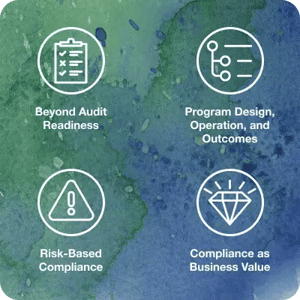 Compliance effectiveness is not just about whether a company has the right policies, procedures, and controls on paper. It is about whether those elements work in practice. An effective compliance program helps the organization understand its risks, detect problems early, respond consistently, and improve when weaknesses are found.
In other words, effectiveness is not measured by the existence of a program, but by its performance. The key question is not “Do we have compliance processes?” but “Do these processes actually help us prevent, detect, and respond to misconduct and regulatory risk?”
Effective compliance is more than being “Audit-ready”
Being audit-ready is important, but it is not the same as being effective. A company may have documented policies, completed training records, and formal reporting channels, while still having weak internal trust, inconsistent investigations, or unresolved control gaps.
Audit readiness shows that certain requirements are in place. Compliance effectiveness shows whether those requirements influence real behavior and decision-making. The difference matters because many compliance failures happen not because a company had no rules, but because the rules were not understood, followed, tested, or enforced consistently.
Design, Operation, and Outcomes
A useful way to assess the effectiveness of the compliance is to look at three levels: design, operation, and outcomes.
Design shows whether the compliance program is properly built for the organization’s risks, size, industry, and regulatory environment. This includes policies, reporting channels, investigation procedures, roles, responsibilities, controls, and training.
Operation shows whether the program actually works day to day. Are employees using reporting channels? Are cases assigned and investigated on time? Are controls tested? Are corrective actions tracked? Are managers and business units involved when needed?
Outcomes show whether the program creates measurable results. These may include earlier issue detection, faster remediation, fewer repeated violations, stronger reporting culture, better control performance, and more useful reporting for leadership.
Risk assessment, Control testing, Remediation, and Adaptation
Effective compliance programs are built around risk, not around generic checklists. This starts with regular risk assessment: identifying which areas of the business are most exposed to misconduct, regulatory breaches, conflicts of interest, fraud, third-party risk, or other compliance threats.
But identifying risks is not enough. Organizations also need to test whether their controls work in practice. If controls fail, the next step is not only to close the specific issue, but to understand the root cause. Was the policy unclear? Was the process too manual? Were responsibilities undefined? Was there pressure from management? Was the control poorly designed?
Real effectiveness appears when the organization uses these findings to improve. That means remediating weaknesses, updating policies, improving training, strengthening controls, and tracking whether corrective actions are completed.
Business value of compliance
The business value of compliance comes from reducing uncertainty and helping the organization make better decisions. A strong compliance program can protect the company from fines, investigations, litigation, reputational damage, operational disruption, and loss of trust.
It also creates value in less obvious ways. It helps leadership see where risks are growing, where processes are breaking down, and where resources should be focused. It supports a healthier speak-up culture, improves accountability, and gives the board better visibility into the organization’s ethical and regulatory health.
This is why compliance should not be measured only as a cost. When measured properly, compliance becomes a source of risk intelligence, business protection, and long-term organizational resilience.
Start with business objectives and risk priorities
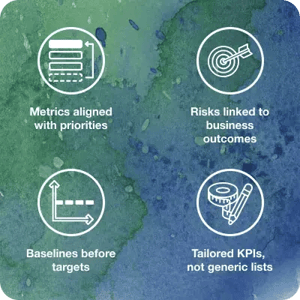 Compliance metrics should not be selected in isolation. The starting point is the business context: what the organization is trying to achieve, what risks could prevent it from getting there, and where compliance can provide meaningful protection or insight.
A company expanding into new markets may need stronger third-party and anti-bribery metrics. A company with high employee turnover may need to focus on training, culture, and speak-up indicators. A company facing regulatory scrutiny may need more detailed evidence of remediation, control testing, and board oversight. The right metrics depend on what matters most to the business.
Align metrics with what the business actually cares about
Compliance teams often report metrics that are easy to collect, but not always useful for decision-making. For example, training completion rates are simple to measure, but they may not tell leadership whether employees understand the rules or apply them in real situations.
Better metrics connect compliance activity to business priorities. If leadership cares about reducing investigation delays, track time to close cases and overdue actions. If the company wants to strengthen trust, track reporting channel usage, employee confidence in speaking up, and retaliation-related concerns. If the business depends on high-risk suppliers, track third-party screening, due diligence completion, and unresolved red flags.
The goal is to show how compliance supports the organization’s real priorities, not just how many compliance tasks were completed.
Map compliance risks to business outcomes
Each compliance risk should be connected to a potential business impact. This makes metrics easier for executives and board members to understand.
For example, slow investigation handling can increase legal and reputational exposure. Weak reporting culture can delay misconduct detection. Repeated policy breaches may point to control failures. Poor third-party due diligence can create corruption, sanctions, or supply chain risks.
This mapping helps compliance teams move from abstract risk language to practical business relevance. Instead of reporting “15 policy exceptions,” the team can explain what those exceptions may mean for operational discipline, regulatory exposure, or control effectiveness.
Define baselines before setting targets
Before setting ambitious goals, organizations need to understand their current position. A baseline shows what is normal for the organization today and creates a reference point for future improvement.
Useful baselines may include the average number of reports per quarter, average investigation closure time, substantiation rate, percentage of overdue corrective actions, training assessment scores, or number of repeat findings. Without a baseline, it is difficult to know whether a metric is improving, declining, or simply fluctuating.
Baselines also help avoid misleading conclusions. For example, an increase in whistleblowing reports may look negative at first, but it could actually mean employees are becoming more aware of reporting channels and more willing to speak up.
Avoid one-size-fits-all KPI lists
There is no universal list of compliance KPIs that works for every organization. A metric that is critical for a financial institution may be less relevant for a manufacturing company. A fast-growing startup may need different indicators than a mature multinational group.
The best compliance metrics are specific to the organization’s risk profile, maturity, industry, geography, and strategic goals. They should be clear, measurable, and useful for action.
A strong test is simple: if a metric changes, would anyone make a decision based on it? If the answer is no, the metric may not belong in the main compliance dashboard.
KPIs, KRIs, leading and lagging indicators: what to track
Once the organization understands its business priorities and compliance risks, the next step is choosing the right indicators. A balanced measurement framework should not rely on one type of metric. It should include indicators that show how the compliance program is performing today and indicators that warn where risks may grow tomorrow.
This is where the difference between KPIs, KRIs, leading indicators, and lagging indicators becomes important.
Compliance KPIs vs KRIs
Compliance KPIs, or key performance indicators, measure how well the compliance program is operating. They help answer questions such as: Are cases handled on time? Are corrective actions completed? Are employees trained? Are controls tested? Are reporting channels being used?
KRIs, or key risk indicators, focus on risk exposure. They help answer a different question: Where might a serious problem appear next? Examples include increasing policy exceptions, overdue remediation actions, repeated findings in the same department, low reporting rates in high-risk regions, or a growing number of unresolved third-party red flags.
In simple terms, KPIs show performance. KRIs show risk signals. Both are needed to understand whether compliance is active, effective, and focused on the right issues.
Lagging and Leading indicators: their difference
Lagging and leading indicators serve different purposes in compliance measurement. Lagging indicators explain what has already happened, while leading indicators help identify where risk may appear next.
A strong compliance framework should use both: one for accountability and trend analysis, the other for prevention and early action.
| Group of indicators | What they are used for | Indicators |
|---|---|---|
|
Lagging indicators
|
Show past events and outcomes. They help compliance teams understand what happened, where issues occurred, and how the organization responded. They are useful for accountability, trend analysis, and reporting, but they usually reveal problems after they have already occurred.
|
|
|
Leading indicators
|
Help identify risks before they turn into major incidents. They show patterns, weaknesses, and pressure points early, so the organization can act before issues escalate.
|
|
Why do you need both
Lagging and leading indicators serve different purposes. Lagging indicators help explain what already happened. Leading indicators help prevent what could happen next.
Used together, they give a fuller picture of compliance effectiveness. For example, the number of substantiated cases shows past misconduct, while time to detection shows whether the organization is finding issues early enough. Training completion shows participation, while post-training assessments and repeat violations show whether the training is having an effect.
A strong compliance measurement framework should combine both. This helps the organization move from passive reporting to active risk management. Instead of only telling leadership what went wrong last quarter, compliance can show where risks are emerging and what actions should be taken before they escalate.
Core compliance metrics every program should consider
There is no single set of compliance metrics that works for every organization. The right metrics depend on the company’s risks, industry, maturity, regulatory exposure, and business priorities. Still, most compliance programs should track a balanced set of indicators across several core areas: reporting, investigations, remediation, training, controls, culture, and cost.
The goal is not to measure everything. The goal is to select metrics that help the organization understand whether compliance processes are working, where risks are increasing, and where action is needed.
| Metric area | What it helps measure | Examples of metrics |
|---|---|---|
| Speak-up and whistleblowing metrics | Whether employees and external stakeholders know how to raise concerns and trust the process enough to use it. These metrics also help assess reporting culture and early issue detection. |
|
| Investigation and case management metrics | Whether reported concerns are handled consistently, fairly, and on time. They also help identify bottlenecks in the investigation process. |
|
| Remediation and corrective action metrics | Whether the organization addresses root causes and follows through after findings. These metrics show whether compliance is driving real change, not just closing cases. |
|
| Training and policy effectiveness metrics | Whether employees not only complete required training and attest to policies, but also understand and apply them in practice. |
|
| Control testing and audit metrics | Whether compliance processes and controls are working as designed. They help identify weaknesses before they become serious incidents. |
|
| Culture and ethical climate metrics | Whether formal compliance processes are supported by real employee trust, ethical behavior, and willingness to speak up. These metrics help reveal risks that may not appear in case numbers alone. |
|
| Cost and efficiency metrics | How compliance uses resources and where better processes or technology could reduce manual work. These metrics help build the business case for compliance investment. |
|
How to calculate compliance ROI and business value
Compliance ROI is difficult to calculate with perfect precision, but it is still important to estimate. Without a clear business case, compliance can easily be seen as a necessary expense rather than a function that protects value, reduces losses, and improves decision-making.
The goal is not to claim that compliance can prevent every incident or convert every risk into a precise financial number. The goal is to show, credibly and practically, how compliance helps the organization avoid losses, use resources more efficiently, and make risk-based decisions.
Why ROI is difficult but necessary
Compliance often creates value by preventing negative outcomes. This makes its impact harder to prove than revenue growth or cost reduction. If no serious violation, fraud case, regulatory fine, or reputational crisis occurs, it can be difficult to show exactly how much the compliance program contributed.
Still, this does not mean ROI should be ignored. Boards and executives need to understand whether compliance investments are proportional to the risks the organization faces. They also need to see whether technology, staffing, training, reporting channels, and investigation processes are improving the company’s ability to detect and manage risk.
The basic compliance ROI formula
A simple way to estimate compliance ROI is to compare the value created or protected by the program with the total cost of running it.
Compliance ROI = (Avoided losses + efficiency gains − compliance investment) / compliance investment
This formula should be treated as a practical framework, not an exact science. It helps compliance teams organize the business case around three core areas:
- what losses the program may help avoid;
- what operational efficiency it creates;
- what the organization spends to maintain the program.
Avoided losses
Avoided losses are the potential costs the organization reduces through better prevention, detection, and response. These may include regulatory fines, legal costs, fraud losses, investigation costs, reputational damage, customer loss, operational disruption, or the cost of repeated misconduct.
For example, if stronger reporting channels help detect misconduct earlier, the company may reduce the scale of the issue before it becomes a legal or public crisis. If better third-party due diligence prevents work with a high-risk vendor, the organization may avoid corruption, sanctions, or supply chain exposure.
Avoided losses should be estimated carefully. The most credible approach is to use internal historical data, industry benchmarks, regulatory enforcement examples, or scenario-based risk assessments.
Efficiency gains
Efficiency gains show how compliance helps the organization save time and resources. This is especially relevant when structured workflows, automation, dashboards, and centralized case management replace manual work.
Examples may include:
- less time spent collecting data for reports;
- faster case assignment and investigation handling;
- fewer duplicated tasks across teams;
- faster evidence collection;
- automated reminders for overdue actions;
- reduced time spent preparing board reports;
- better visibility into open cases and remediation status.
These gains are easier to quantify than avoided losses. For example, if a compliance team saves 20 hours per month on manual reporting, that time can be translated into cost savings based on employee time and resource allocation.
Risk reduction as business value
Not every compliance benefit needs to be expressed as a direct financial return. Some of the most important business value comes from reducing uncertainty and improving control over risk.
This includes:
- earlier detection of misconduct;
- faster remediation;
- fewer repeat issues;
- better board oversight;
- stronger employee trust;
- clearer accountability;
- improved regulatory readiness;
- more consistent investigation handling.
These outcomes may not always produce an immediate financial number, but they make the organization more resilient. For executives and board members, this is often just as important as direct cost savings.
What not to overclaim
Compliance teams should be careful not to exaggerate ROI. Overclaiming can weaken credibility, especially with finance, legal, or board stakeholders.
Avoid statements like “compliance prevented exactly $5 million in losses” unless there is a clear methodology behind the number. It is better to present ROI as an evidence-based estimate, supported by assumptions, benchmarks, and internal data.
A strong business case should be realistic. It should show where compliance clearly saves time, where it likely reduces exposure, and where better measurement is still needed. The more transparent the assumptions, the more credible the value story becomes.
Turning compliance data into board-ready reporting
Compliance data only becomes valuable when it helps leadership understand risk and make decisions. A board report should not be a collection of disconnected numbers. It should explain what is changing, where the organization is exposed, what actions are being taken, and where board attention may be needed.
The goal is to turn compliance reporting from a status update into a decision-making tool. This means presenting metrics with context, trends, thresholds, and clear implications for the business.
What the board actually needs to see
Board members do not need every operational detail. They need a clear view of the organization’s compliance health and the risks that may affect strategy, reputation, financial performance, or regulatory exposure.
A useful board report should answer questions such as:
- What are the top compliance risks right now?
- Are these risks increasing, decreasing, or stable?
- Are issues being detected early enough?
- Are investigations handled on time?
- Are corrective actions completed?
- Are the same problems repeating?
- Are there areas where resources, controls, or oversight need strengthening?
The board needs enough detail to perform oversight, but not so much that the core message gets lost.
Separate operational dashboards from board reports
Compliance teams often need detailed dashboards to manage daily work: open cases, deadlines, assigned owners, overdue tasks, investigation notes, and remediation progress. This level of detail is useful for operations, but it is usually too granular for board reporting.
A board report should be more selective. It should focus on high-risk trends, significant incidents, unresolved issues, and decisions that require leadership attention.
A practical structure is to separate reporting into three levels:
- Operational dashboard: used by compliance teams to manage cases, tasks, deadlines, and workflows.
- Executive dashboard: used by senior management to understand risk exposure, resource needs, and cross-functional issues.
- Board report: used for oversight, strategic risk discussion, major trends, and accountability.
This separation helps ensure that each audience gets the level of information it actually needs.
Use Trends, Thresholds, and Context
Raw numbers can be misleading without context. For example, saying that the company received 40 reports this quarter does not explain whether this is good, bad, expected, or concerning.
A stronger report would show:
- how this compares to previous quarters;
- which categories increased or decreased;
- whether reports came from high-risk areas;
- how many cases were substantiated;
- how quickly they were handled;
- whether corrective actions were completed;
- what the trend may indicate.
Thresholds also help leadership understand when a metric requires attention. For example, if more than 15% of corrective actions are overdue, this may trigger escalation. If investigation closure time exceeds the target for two consecutive quarters, this may indicate a resource or process issue.
Context turns numbers into insight. It helps the board understand not only what happened, but why it matters.
Show decisions, not just data
A board-ready report should make the next step clear. If the data shows a problem, the report should explain what decision or action is needed.
For example:
- If reports are rising in one region, does the company need targeted training or a local culture review?
- If corrective actions are overdue, does leadership need to assign stronger ownership?
- If repeated issues appear in the same process, does the control need redesign?
- If high-risk cases take too long to close, does the compliance team need more resources?
- If reporting is low in a high-risk area, does the organization need to improve awareness and trust?
The best compliance reports do not leave leadership guessing. They connect data to risk, risk to action, and action to accountability.
Example Board dashboard structure
A board dashboard should be simple enough to read quickly, but strong enough to support oversight. One practical structure is to organize it around a few high-value sections.
|
Dashboard section |
What it shows |
Why it matters |
|
Top compliance risks |
Highest current risks by category, region, or business unit |
Focuses board attention on the most important exposure |
|
Speak-up health |
Reporting trends, channels used, anonymous reports, retaliation concerns |
Shows whether employees and stakeholders trust the reporting process |
|
Investigation performance |
Open cases, overdue cases, average time to close, high-risk investigations |
Shows whether issues are handled consistently and on time |
|
Remediation status |
Corrective actions completed, overdue actions, repeat findings |
Shows whether the organization fixes root causes |
|
Control and audit findings |
Failed controls, audit findings, recurring weaknesses |
Shows whether compliance processes work as intended |
|
Culture indicators |
Survey results, confidence in reporting, ethical climate signals |
Shows whether formal processes are supported by real behavior |
|
Business value indicators |
Avoided losses, efficiency gains, reduced manual work, improved response times |
Connects compliance performance to business value |
This kind of structure helps move the conversation from “what did compliance do?” to “what does the organization need to know, decide, and improve?”
Compliance maturity: from manual reporting to strategic value
 Compliance measurement becomes more useful as the program matures. Many organizations start with manual tracking, scattered data, and basic reports. Over time, they can move toward structured workflows, risk-based indicators, board-ready reporting, and clearer evidence of business value.
A compliance maturity model helps organizations understand where they are today and what should improve next — from reactive compliance to strategic compliance value.
For a deeper breakdown of each maturity stage, read our guide: Compliance Maturity Model: From Reactive to Strategic Compliance.
How technology helps measure compliance effectiveness
Compliance measurement becomes much harder when data is scattered across emails, spreadsheets, shared folders, hotline records, audit reports, and separate HR or legal systems. Even if the organization collects useful information, it may still struggle to connect it into one clear picture.
Technology helps by turning compliance activity into structured data. Reports, cases, investigation steps, corrective actions, deadlines, ownership, and outcomes can be tracked consistently. This makes it easier to see patterns, identify delays, measure performance, and prepare reports for executives and the board.
Why spreadsheets are not enough
Spreadsheets can work for early-stage tracking, but they become weak as the compliance program grows. They are easy to break, hard to audit, and difficult to manage when several people or teams are involved.
Common problems include:
- data is entered manually and inconsistently;
- case status is not always up to date;
- deadlines and overdue actions are easy to miss;
- there is limited audit trail;
- access control is difficult to manage;
- reporting takes too much manual work;
- trends are hard to identify across departments, regions, or issue types.
The main issue is not that spreadsheets are “bad.” The issue is that they are not built to manage complex compliance workflows, sensitive reports, investigations, remediation, and leadership reporting at scale.
Centralized data for reports, cases, actions, and trends
A stronger approach is to centralize compliance data in one system. This gives compliance teams a single place to manage reports, assign cases, track investigation progress, document decisions, and follow corrective actions until completion.
Centralized data also improves measurement. Instead of collecting numbers manually before every report, the organization can track metrics continuously: how many cases are open, how long investigations take, which actions are overdue, which categories are increasing, and where repeated issues appear.
This is especially useful when compliance data comes from multiple channels. Reports may arrive through a web form, hotline, email, manager, or other internal process. If these inputs are structured in one system, the organization can compare them, analyze them, and use them for better risk oversight.
From case management to business intelligence
Case management is not only about closing individual reports. Each case can become a source of insight about the organization’s risks, controls, culture, and response quality.
For example:
- repeated reports in one department may show a local culture issue;
- overdue investigations may show lack of resources or unclear ownership;
- recurring corrective actions may show a weak control;
- low reporting in a high-risk area may show lack of trust or awareness;
- long time to remediation may show that issues are identified but not fixed.
When this data is structured and analyzed over time, compliance teams can move from administrative case handling to business intelligence. They can show leadership not only what happened, but where risks are concentrated, how the organization is responding, and what needs to change.
What a good compliance analytics system should support
A good compliance analytics system should help teams manage daily work and support higher-level reporting. It should make compliance data easier to collect, protect, analyze, and present.
Key capabilities include:
- secure intake from multiple reporting channels;
- structured case registration;
- case categories, severity levels, and statuses;
- role-based access rights;
- task assignment and ownership;
- SLA and deadline tracking;
- escalation workflows;
- corrective action tracking;
- audit trail and documentation history;
- dashboards by category, department, region, or risk area;
- substantiation rate and case outcome analytics;
- overdue case and overdue action monitoring;
- exportable reports for executives and the board.
The value of technology is not only automation. It helps compliance teams create a more reliable measurement system. When reports, investigations, and corrective actions are tracked consistently, the organization can prove compliance effectiveness with better evidence, less manual work, and clearer insight for decision-making.
Common mistakes in measuring compliance effectiveness
Even well-developed compliance programs can measure the wrong things or interpret useful data in the wrong way. The problem is usually not a lack of numbers. The problem is a lack of focus, context, and connection to real business decisions.
Avoiding these common mistakes helps compliance teams build reports that are more useful for leadership and more actionable for the organization.
Measuring too many metrics
More metrics do not automatically mean better measurement. If a dashboard includes too many indicators, the most important signals can get lost.
A compliance team may track dozens of numbers: reports, trainings, policy attestations, audit findings, investigation timelines, corrective actions, survey results, and more. All of them may be useful somewhere, but not all of them belong in executive or board reporting.
A better approach is to separate metrics by audience and purpose. Operational teams may need detailed data. Executives need trends, risks, and resource implications. The board needs high-level oversight and decision points.
A useful test is simple: if this metric changes, would anyone take action? If not, it may not belong in the main dashboard.
Reporting numbers without interpretation
Numbers do not speak for themselves. A report that says “45 cases were received this quarter” does not explain whether the organization is improving, declining, or facing a new risk.
Every important metric should be interpreted. Compliance teams should explain what changed, why it matters, and what action may be needed.
For example, an increase in reports could mean several different things:
- risk is rising;
- awareness of reporting channels is improving;
- employees trust the process more;
- one department has a specific issue;
- a recent training campaign encouraged more reporting.
Without interpretation, leadership may draw the wrong conclusion. Good reporting connects the number to context, trend, and business meaning.
Treating low reporting as good news
Low reporting is one of the most commonly misunderstood compliance signals. Some organizations assume that fewer reports mean fewer problems. Sometimes that may be true, but often it is not.
Low reporting can also mean that employees do not know how to report, do not trust the process, fear retaliation, or believe nothing will change. This is especially concerning in high-risk departments, regions, or business units where silence may hide serious issues.
To interpret low reporting properly, it should be compared with other signals: culture survey results, employee turnover, HR complaints, audit findings, management pressure, and informal feedback. If reporting is low but other risk indicators are high, the organization may have a speak-up problem, not a low-risk environment.
Ignoring culture and qualitative data
Compliance effectiveness cannot be measured only through quantitative metrics. Numbers show what happened, but they do not always explain why it happened.
Culture and qualitative data help fill that gap. Employee surveys, focus groups, manager feedback, exit interviews, whistleblowing narratives, and ethics climate checks can show whether people understand the rules, trust reporting channels, and believe misconduct will be handled fairly.
For example, a training completion rate may be high, but employee feedback may show that people still do not know how to apply the policy in real situations. A hotline may be available, but survey results may show that employees are afraid to use it.
Ignoring culture creates a false sense of security. A program can look strong in dashboards while real behavioral risks remain hidden.
Not tracking remediation after findings
Finding a problem is only the first step. A compliance program proves its effectiveness by fixing the issue and reducing the chance that it happens again.
If remediation is not tracked, the organization may close investigations without solving root causes. The same findings may return in future audits, the same teams may repeat the same violations, and corrective actions may remain unfinished.
Useful remediation metrics include:
- corrective actions created;
- corrective actions completed on time;
- overdue remediation tasks;
- repeated findings after remediation;
- time from finding to resolution;
- root causes addressed;
- control improvements implemented.
This is where compliance measurement becomes practical. It shows whether the organization learns from issues or simply documents them.
Using metrics only for reporting, not for decisions
Compliance metrics should not exist only to fill quarterly reports. They should help the organization decide what to do next.
If case closure time is increasing, the organization may need more investigation resources or clearer workflows. If corrective actions are overdue, ownership may need to be escalated. If reports are concentrated in one department, leadership may need to review local management practices. If training scores are weak in a high-risk function, the training should be redesigned.
The real value of compliance measurement is not the dashboard itself. It is the decisions the dashboard supports. Metrics should help leadership allocate resources, strengthen controls, improve culture, and reduce risk before problems become larger.
How to build your compliance measurement framework step by step
A compliance measurement framework does not need to start as a complex dashboard. It can begin with a clear structure: what the organization wants to protect, which risks matter most, what data is available, and which metrics can support better decisions.
The goal is to create a repeatable process for measuring compliance performance, interpreting results, and improving the program over time.
Step 1 — Define business and compliance objectives
 Start by clarifying what the compliance program is expected to support. This may include regulatory readiness, misconduct prevention, stronger speak-up culture, faster investigations, third-party risk management, fraud prevention, or better board oversight.
The objectives should be specific enough to guide measurement.
For example, “improve compliance” is too broad. “Reduce investigation delays,” “increase trust in reporting channels,” or “track completion of corrective actions” are easier to measure and manage.
Step 2 — Identify key risk areas
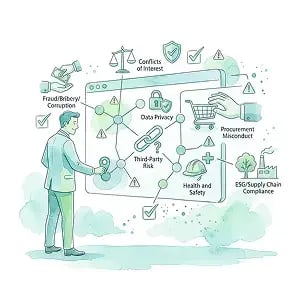 Next, identify the compliance risks that matter most to the organization. These risks will depend on the company’s industry, geography, size, business model, and regulatory environment.
Common risk areas include:
- fraud;
- bribery and corruption;
- conflicts of interest;
- harassment or discrimination;
- data privacy;
- sanctions or export controls;
- third-party risk;
- procurement misconduct;
- health and safety;
- ESG or supply chain compliance.
This step helps prevent the organization from measuring generic indicators that do not reflect its real exposure.
Step 3 — Select metrics for each risk area
 For each key risk area, choose a small number of meaningful metrics. A good mix should include both performance indicators and risk indicators.
For example, for investigation management, useful metrics may include average time to close cases, overdue investigations, case severity, substantiation rate, and repeat allegations. For speak-up culture, useful metrics may include employee reporting rate, anonymous vs. named reports, trust survey results, retaliation concerns, and time to acknowledge reports.
The best metrics are clear, measurable, and actionable. If a metric changes, the organization should know what decision or follow-up action it may trigger.
Step 4 — Define data sources and owners
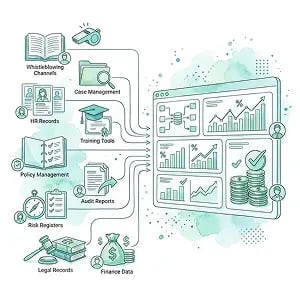 Every metric needs a reliable data source and a clear owner. Otherwise, reporting becomes inconsistent and difficult to trust.
Data may come from whistleblowing channels, case management systems, HR records, training platforms, policy management tools, audit reports, risk registers, legal records, or finance systems.
Each metric should have an assigned owner responsible for data quality, updates, and interpretation.
This avoids a common problem where compliance reports depend on last-minute manual collection from multiple teams.
Step 5 — Set thresholds and reporting frequency
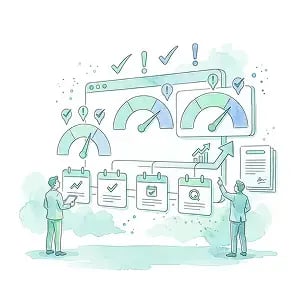 Metrics become more useful when the organization defines what “normal,” “warning,” and “critical” look like.
For example:
- if more than 10% of corrective actions are overdue, this may require management review;
- if high-risk cases exceed the target closure time, this may trigger escalation;
- if reporting is unusually low in a high-risk area, this may require a culture or awareness check.
Reporting frequency should match the risk. Operational metrics may need weekly or monthly review. Executive dashboards may be reviewed monthly or quarterly. Board-level reporting is usually less frequent, but should focus on the most important trends, risks, and decisions.
Step 6 — Review, Interpret, Improve
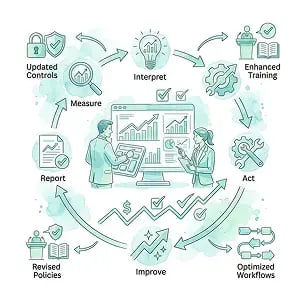 The final step is to turn measurement into continuous improvement. Metrics should not only describe what happened. They should help the organization understand what needs to change.
This means reviewing trends, identifying root causes, discussing results with relevant business owners, and updating controls, training, policies, or workflows based on what the data shows.
A practical cycle looks like this:
measure → interpret → act → improve → report
When this cycle works well, compliance measurement becomes more than reporting. It becomes a management tool that helps the organization detect risks earlier, fix problems faster, and prove the business value of the compliance program.
Conclusion: compliance value must be measured, not assumed
Compliance can no longer rely on the assumption that its value is understood. Boards and executives need clear evidence that the program helps the organization reduce risk, detect problems earlier, respond consistently, and improve over time.
This requires moving beyond activity-based reporting. Completed trainings, signed policies, and closed cases matter, but they are only part of the picture. Real compliance effectiveness is shown through outcomes: stronger controls, faster remediation, fewer repeat issues, healthier speak-up culture, better board visibility, and more informed business decisions.
The most effective compliance teams use measurement as a management tool, not just a reporting exercise. They connect metrics to business objectives, track both leading and lagging indicators, interpret the data in context, and use insights to improve the program. When this happens, compliance becomes more than a regulatory function. It becomes a source of risk intelligence, accountability, and long-term business value.