

The ACFE 2026 Report to the Nations confirms something that has remained remarkably consistent throughout three decades of occupational fraud research: people are still one of the strongest fraud-detection mechanisms an organization has.
In 2026, 43% of occupational fraud cases were detected through tips — nearly three times as many as through internal audit, the next most common detection method. Employees generated 55% of those tips, while web-based reporting became the most widely used formal reporting mechanism at 46%.
The latest report also shows how reporting itself is changing. Whistleblowers are increasingly using digital channels, while telephone hotline use continues to decline. At the same time, organizations with formal reporting mechanisms detected fraud faster and experienced lower median losses than organizations without them.
So, what should compliance and anti-fraud teams take from the 2026 findings?
ACFE Report to the Nations 2026: key figures
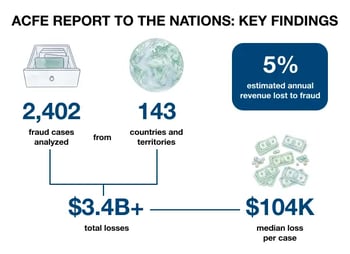 The 14th edition of the Report to the Nations analyzed 2,402 occupational fraud cases across 143 countries and territories.
Together, those cases caused more than $3.4 billion in losses. The median loss per case was $104,000, while the average loss reached $1.457 million. Certified Fraud Examiners surveyed by ACFE continue to estimate that organizations lose approximately 5% of their revenue to fraud each year.
Source: ACFE, Occupational Fraud 2026: A Report to the Nations
The scale is significant, but one of the most useful findings for compliance teams is not simply how much fraud costs. It is how organizations discover it.
How is occupational fraud most often detected?
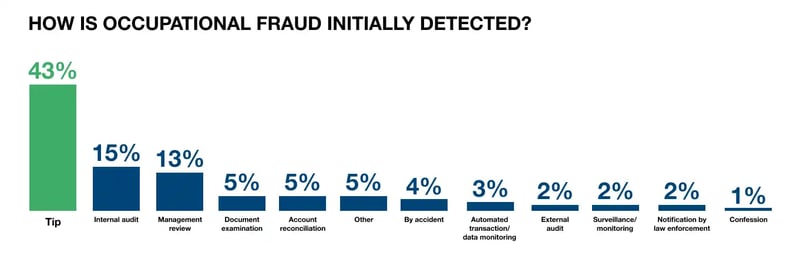
Tips remain the number one method of occupational fraud detection.
In the 2026 study:
- 43% of fraud cases were detected through a tip;
- 15% through internal audit;
- 13% through management review.
Together, these three methods accounted for more than 70% of the fraud cases studied by ACFE.
Despite advances in automated monitoring, data analytics, audits, and other anti-fraud controls, information provided by people continues to uncover substantially more occupational fraud than any other individual detection method.
Source: ACFE, Occupational Fraud 2026: A Report to the Nations
Tips have led fraud detection for 30 years
This finding is not unique to the 2026 report.
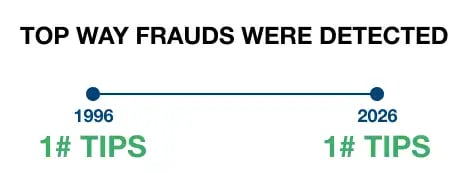
The first Report to the Nations was published in 1996. Thirty years and 14 editions later, ACFE has analyzed more than 24,000 occupational fraud cases.
Across that entire period, one finding has remained constant:
Tips have been the most common fraud detection method in every edition of the Report to the Nations.
Technology has changed dramatically since 1996. Organizations now have access to automated transaction monitoring, sophisticated analytics, digital audit tools, and increasingly advanced fraud detection systems.
Yet people continue to see, hear, and experience things that automated controls may not detect.
This does not make technology less important. It means that effective technology should make it easier and safer for people to communicate what they know.
Source: ACFE, Occupational Fraud 2026: A Report to the Nations
Who reports occupational fraud?
Employees remain the most important source of fraud tips.
In the 2026 study:
- 55% of tips came from employees;
- 21% came from customers;
- 11% came from vendors.
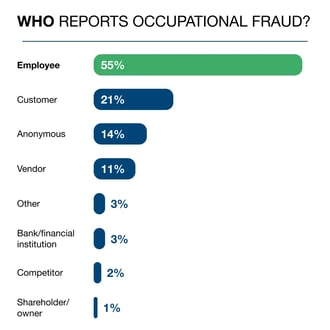 ACFE also found that more than one-third of tips originated from external sources such as customers, vendors, and competitors.
This is an important reminder that a reporting system should not necessarily be designed only for employees.
Customers, suppliers, contractors, partners, and other people outside the organization may also observe misconduct that internal controls cannot easily identify.
For compliance teams, the practical question is therefore not simply whether a reporting channel exists, but who can access it and how easy it is for them to speak up.
Source: ACFE, Occupational Fraud 2026: A Report to the Nations
How do whistleblowers report fraud in 2026?
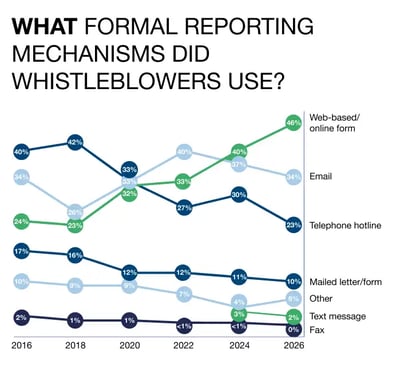 One of the clearest trends in the new report is the continued move toward digital reporting.
Among formal reporting mechanisms used by whistleblowers in 2026:
- 46% used a web-based or online form;
- 34% used email;
- 23% used a telephone hotline.
ACFE notes that the use of web-based and online reporting mechanisms has increased since 2018, while telephone hotline use has steadily declined.
Source: ACFE, Occupational Fraud 2026: A Report to the Nations
The important conclusion is not that organizations should replace every other reporting method with a web form.
Almost one in four formal reports still involved a telephone hotline. ACFE specifically recommends maintaining several reporting channels so whistleblowers can choose a method that suits their situation.
Different reporters have different needs. Some may prefer an online form, others email, and others may feel more comfortable speaking with someone by phone.
A modern reporting program should reflect that.
Do formal reporting mechanisms make a difference?
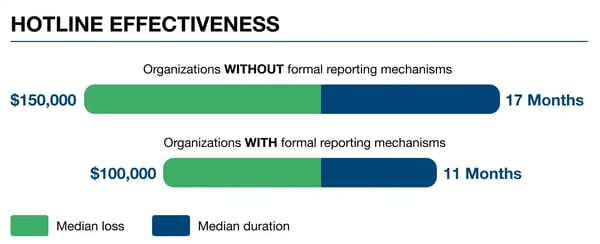
The 2026 data also provides a strong business case for maintaining structured reporting channels.
Organizations with formal reporting mechanisms experienced:
- $100,000 median fraud loss;
- 11 months median fraud duration.
Organizations without formal reporting mechanisms experienced:
- $150,000 median fraud loss;
- 17 months median fraud duration.
In other words, the presence of formal reporting mechanisms was associated with both lower losses and faster detection.
Source: ACFE, Occupational Fraud 2026: A Report to the Nations
These figures should not be interpreted to mean that simply installing a hotline automatically prevents fraud.
A reporting mechanism is one part of a wider anti-fraud system.
But the findings reinforce an important point: organizations benefit when people have a defined way to raise concerns before misconduct continues for longer.
Why does faster fraud detection matter?
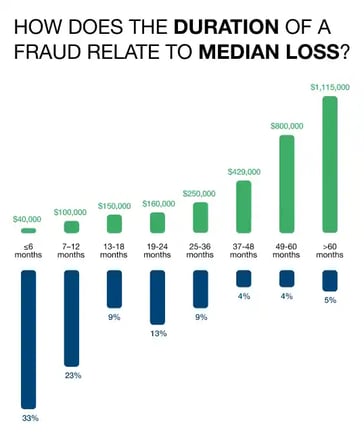 Fraud becomes more expensive the longer it remains undetected.
The 2026 report shows a particularly clear relationship between duration and financial loss.
Frauds detected within the first six months caused a median loss of $40,000.
When schemes continued for 7–12 months, median losses increased to $100,000.
Frauds that remained undetected for more than five years caused a median loss of $1.115 million.
The typical fraud case in the study lasted 12 months before detection.
This makes early reporting more than a cultural issue. It can have a direct financial impact.
Source: ACFE, Occupational Fraud 2026: A Report to the Nations
A reporting channel is not enough: employees need to know how to use it
One of the most useful findings in the 2026 report concerns fraud awareness training.
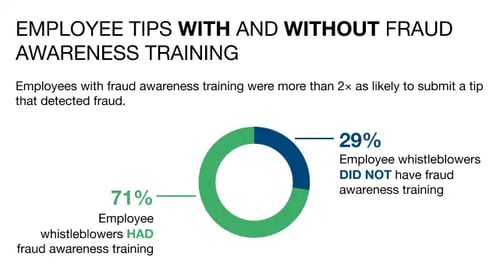
Employees working in organizations that provided fraud awareness training were more than twice as likely to submit a tip that resulted in fraud detection.
Among employee whistleblowers:
- 71% had received fraud awareness training;
- 29% had not.
Yet only 47% of private organizations provided employees with fraud awareness training.
Source: ACFE, Occupational Fraud 2026: A Report to the Nations
This highlights an important limitation of thinking about whistleblowing only in terms of technology.
A company can have an excellent reporting system, but it will have limited value if employees:
- do not know that it exists;
- do not understand what should be reported;
- cannot easily access it;
- or do not trust what will happen after they submit a concern.
We have previously explored how whistleblower training should work in practice, including what employees should understand about reporting procedures, confidentiality, legal protections, and what happens after a report is submitted.
The reporting channel, communication around it, employee training, confidentiality, and follow-up process all need to work together.
What other fraud trends stand out in 2026?
Whistleblowing is only one part of the Report to the Nations. Several broader trends also deserve attention.
Corruption has increased substantially over three decades
In the first Report to the Nations in 1996, corruption was present in approximately 10% of cases. In the 2026 study, corruption was involved in 45% of cases.
That makes corruption an increasingly significant component of occupational fraud risk.
Fraud at the top is much more expensive
Employees and managers each accounted for 41% of perpetrators in the 2026 study, while owners and executives represented only 16%.
But fraud committed by owners and executives caused a median loss of $475,000, compared with $125,000 for managers and $50,000 for employees.
Smaller organizations remain especially vulnerable
Organizations with fewer than 100 employees suffered a median loss of $126,000, the highest median loss among the organization-size categories in the study.
At the same time, only 24% of organizations with fewer than 100 employees had a hotline, compared with 85% of organizations with 100 or more employees.
For smaller companies, fraud losses can also represent a much larger proportion of available resources, making accessible and cost-effective reporting mechanisms particularly important.
What should compliance teams take from the ACFE 2026 report?
The data points to several practical priorities:
 |
 |
|
| Keep multiple reporting channels available. | Connect reporting with investigation and follow-up. | |
| Web-based reporting is now the most widely used formal mechanism, but email and telephone reporting continue to play an important role. |
Receiving a tip is only the first step. Organizations need a structured process for reviewing, investigating, documenting, escalating, and resolving reports. |
 |
 |
|
| Train people to recognize and report fraud. | Make anonymity and confidentiality credible. | |
| The presence of a reporting channel alone is not enough if employees do not understand when and how to use it. | Employees need to trust that raising a concern will not unnecessarily expose their identity or put them at risk. |


ACFE's own fraud-prevention checklist reflects many of these principles.
It recommends providing one or more reporting channels, extending reporting mechanisms to vendors, customers, and other outside parties, supporting anonymous or confidential reporting where legally permissible, and ensuring that employees know how to communicate concerns.
People remain at the center of fraud detection
The tools used to detect fraud are becoming more sophisticated. Reporting itself is moving online. Data analytics, automated monitoring, and other technologies are playing a larger role in anti-fraud programs.
But after 30 years of ACFE research, one fact has remained remarkably stable:
Tips are still the most common way occupational fraud is discovered.
The lesson is not that technology should replace people. It is that technology should make it easier for people to speak up — wherever they are, whichever reporting channel they use, and without unnecessary barriers.
For organizations, that means creating reporting systems that are accessible, trusted, confidential, and connected to a structured investigation process.
Because when people remain your strongest source of fraud detection, making it easier for them to report is not just a compliance measure. It is part of the organization’s fraud risk strategy.